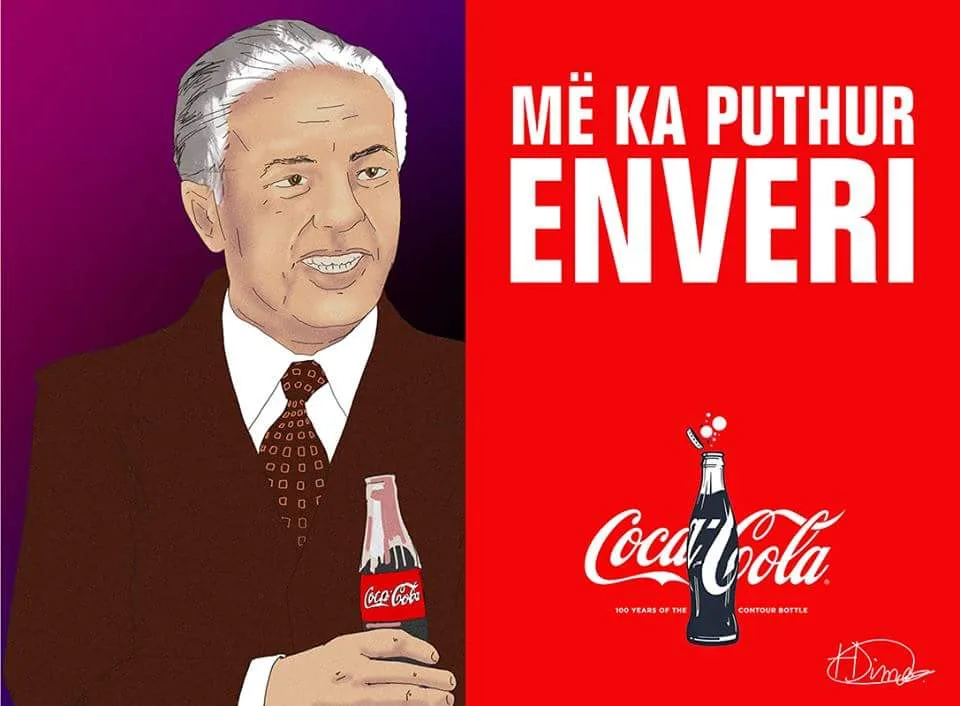
the diploma
Më ka puthur Enveri
In 2015, as I approached the end of my Bachelor in Art and Design at POLIS University’s International School of Architecture and Urban Development Policies in Tirana, I began working on what was supposed to be the final project of my studies — an academic conclusion, a last door to pass through before entering professional life — yet the project gradually became something more enduring: the first conscious formulation of a creative method that, like an invisible thread woven through everything I have produced since, continues to follow me from one project to another.


The diploma project, titled Enver Kissed Me, was built around a deceptively playful question: what happens when political mythology is placed inside the machinery of commercial entertainment, when the solemn face of a dictator is printed on the seductive red surface of a global product, or when history, stripped of its ceremonial distance, begins to behave like a franchise?
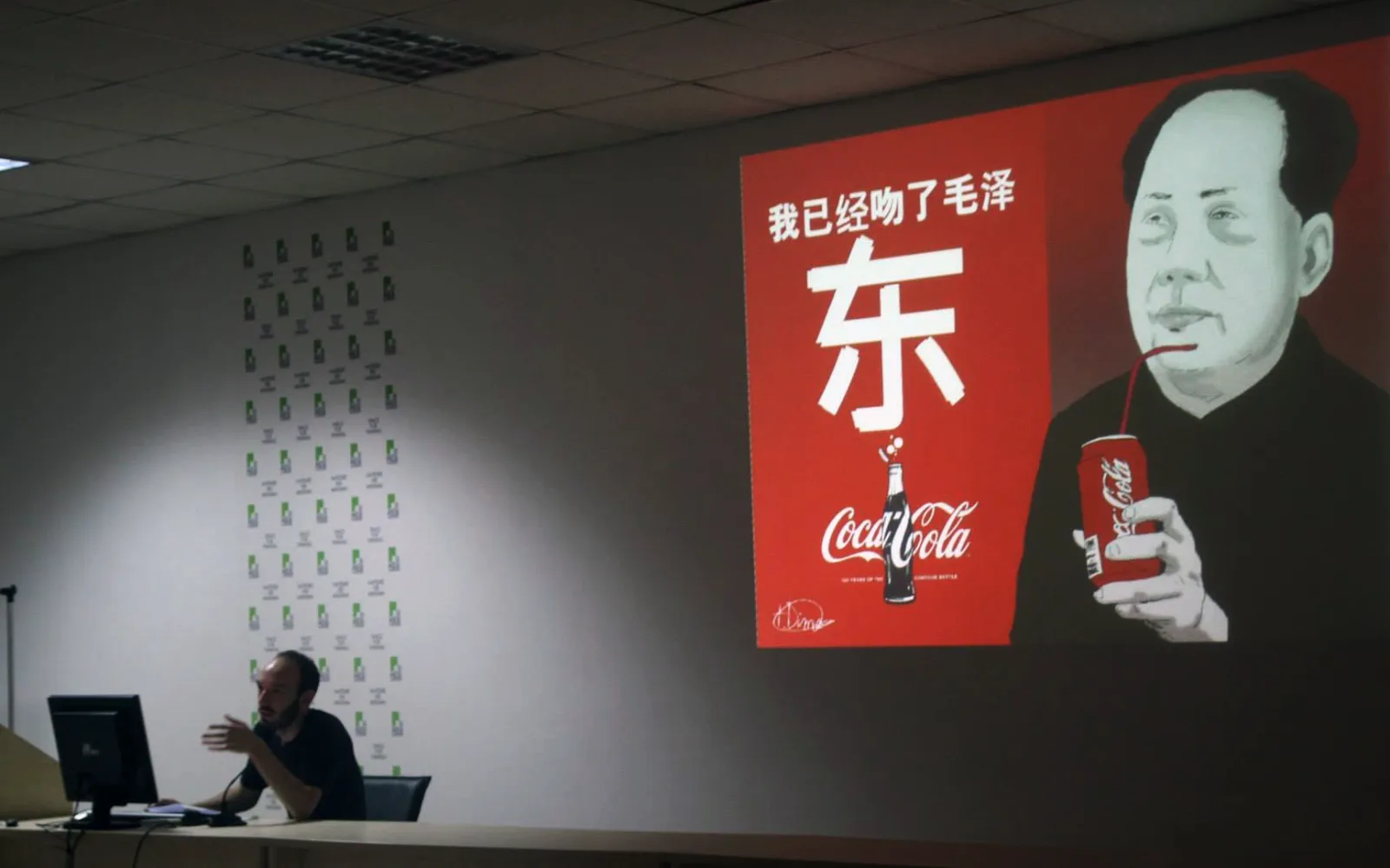
the defence, 2015 — history handed to a franchise
propaganda & advertising
At first glance, the encounter between Enver Hoxha and Coca-Cola, Mao Zedong and the visual language of advertising, or Fidel Castro and the polished aesthetics of consumer packaging could be understood as a graphic joke, an absurd collision between worlds that were never meant to share the same surface. Beneath that initial humour, however, there was a more uncomfortable reflection on the ways power constructs its images, on how propaganda and advertising — although apparently standing on opposite sides of history — often speak through surprisingly similar mechanisms, repeating symbols until they become familiar, transforming familiarity into trust and eventually turning trust into loyalty.
The political leader, the cinematic hero and the commercial brand all depend, in different ways, on the same invisible architecture: an image that must be repeated until it becomes larger than the person, the story or the product from which it originated.
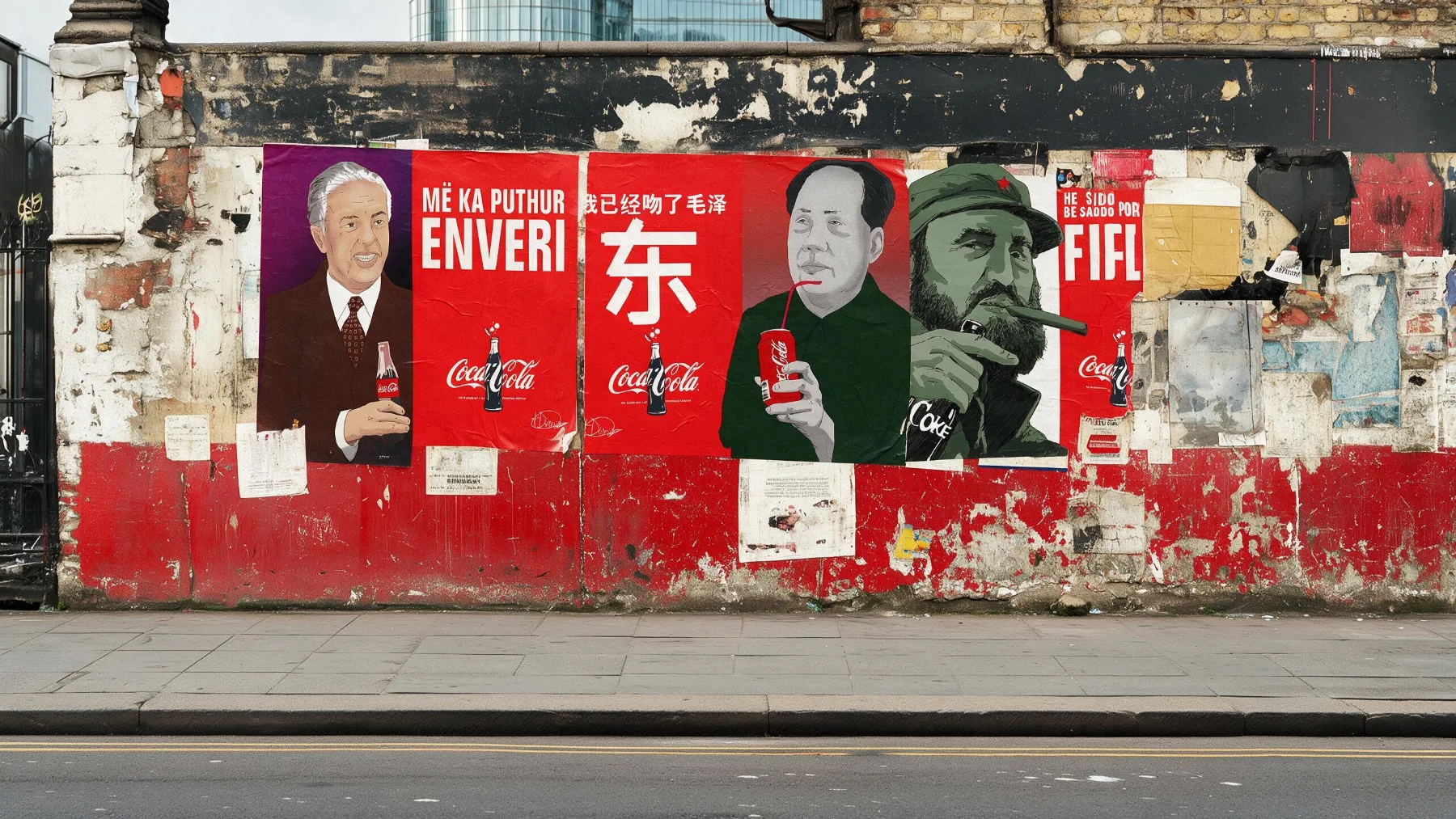
three leaders, one contour bottle
an emotional trap
an emotional trap
Under the guidance of Gëzim Qendro, I was encouraged to move beyond the immediate aesthetic qualities of these combinations and to think more provocatively about what an image could do to its audience. He pushed me to treat viewers not as passive recipients waiting for a message to be explained, but as participants entering an emotional trap, where humour could open the door, familiarity could invite them inside and discomfort could quietly lock the room behind them.
Through this process, I began to understand that a visual message does not always need to declare itself with the certainty of a slogan; sometimes it can operate more powerfully by destabilising what the audience already knows, by allowing recognition and confusion to appear simultaneously, like two reflections trembling on the same surface.
The purpose was not simply to make people laugh, nor to shock them through an arbitrary collision of symbols, but to play with the complicated sequence of their emotions: to let them recognise the familiar face, smile at the absurdity of its new setting and only afterwards realise that the joke had exposed something about the construction of authority, celebrity and collective memory.
pastiche as surgery
Pastiche as cultural surgery
This became the foundation of my fascination with pastiche — not as imitation, and certainly not as the decorative borrowing of a recognisable style, but as a form of cultural surgery through which existing messages could be opened, dismantled and rearranged until they began to speak in unfamiliar voices. A symbol could be removed from its historical body, another could be extracted from the industry that had produced it, and, once the two were placed together, a third context would emerge: a strange territory that belonged neither entirely to politics nor to advertising, neither to historical memory nor to popular entertainment.
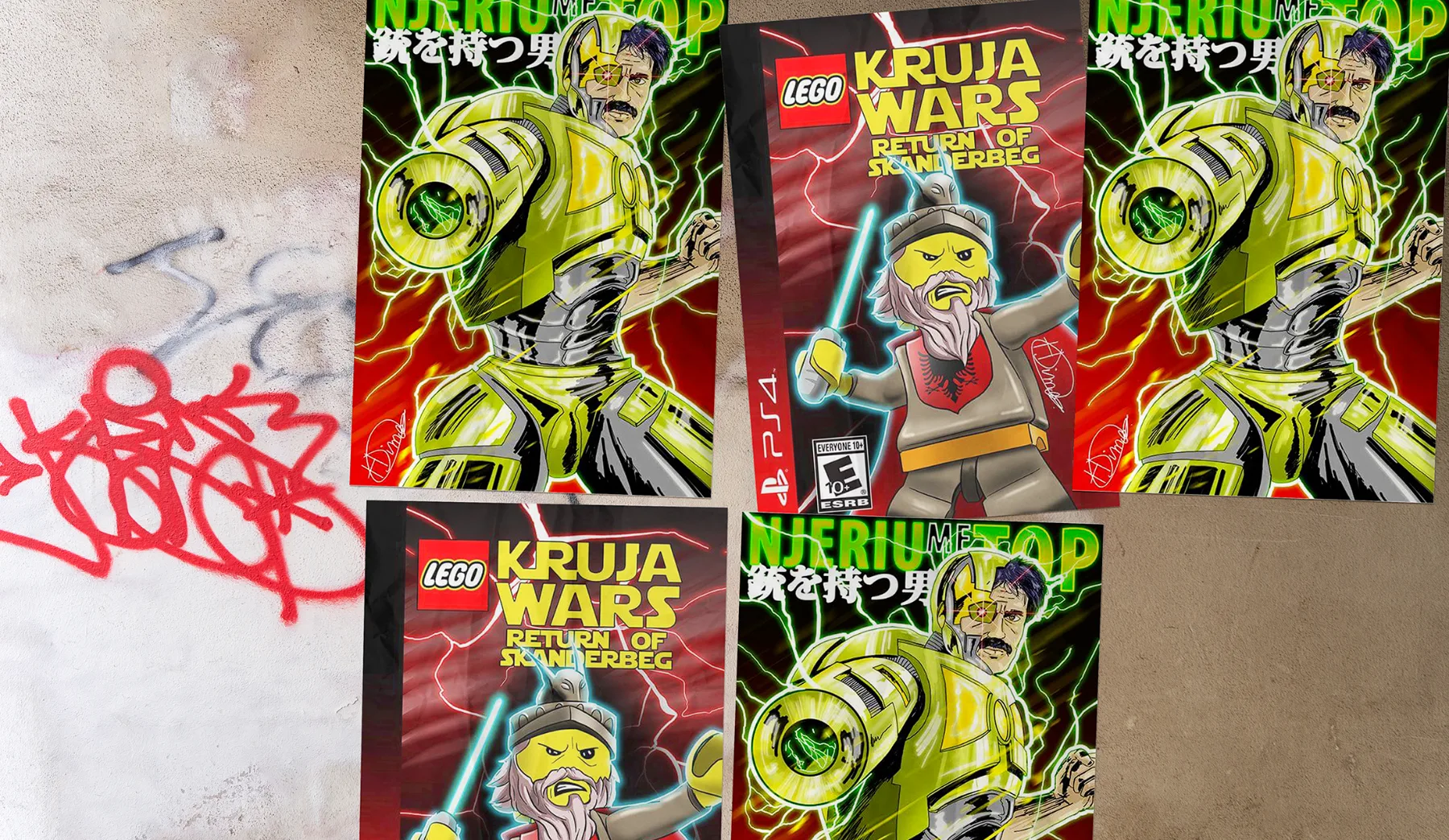
national myth, franchised
the internal archive
It was precisely this territory between meanings that interested me most, because it allowed the reference to remain recognisable while making its conventional interpretation impossible.
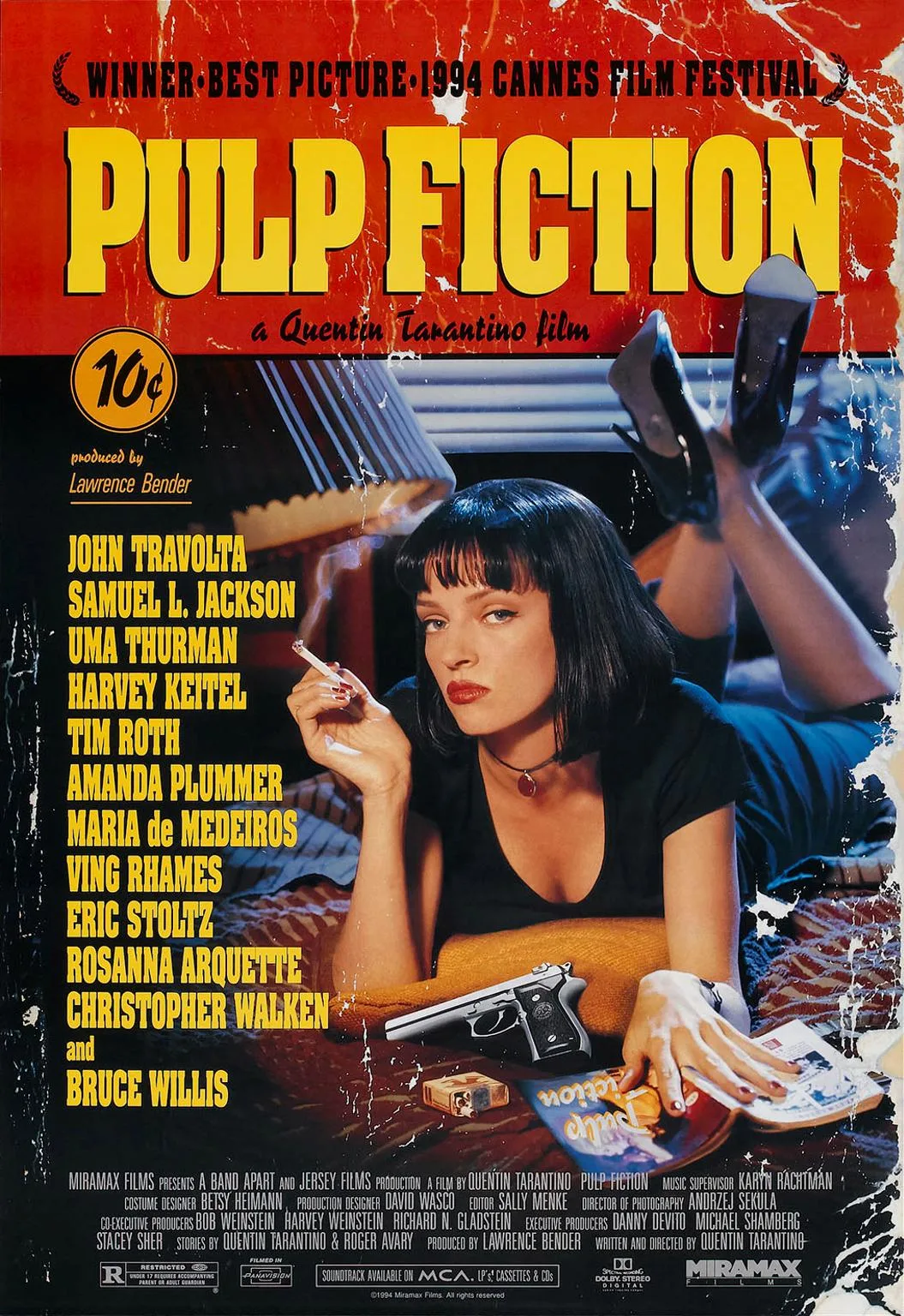
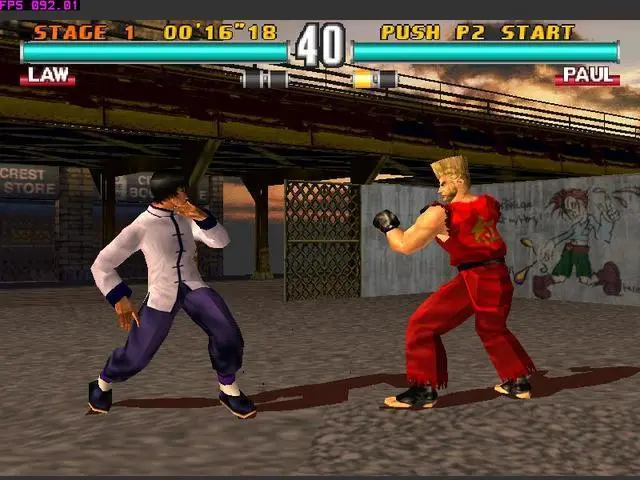
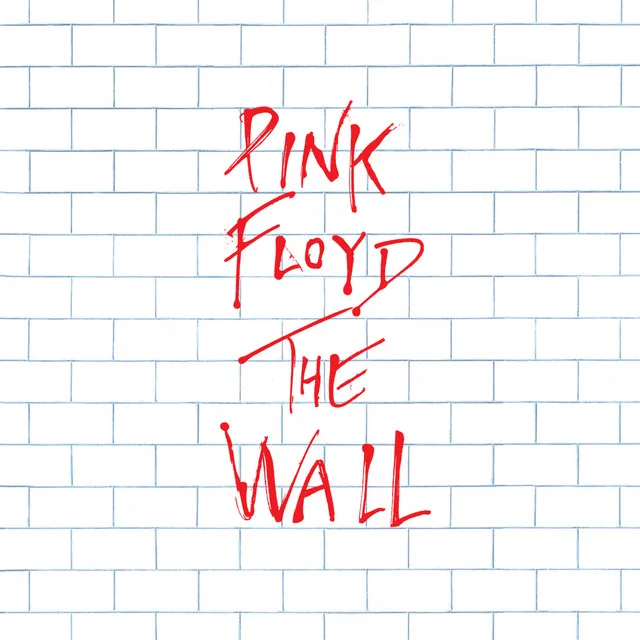
Cinema offered some of the clearest examples of this approach. In the work of directors such as Quentin Tarantino, genres, cinematic memories, musical fragments and visual codes are gathered from distant corners of popular culture and placed into new constellations. Westerns collide with martial-arts films, exploitation cinema meets carefully composed dialogue, forgotten songs return with entirely different emotional meanings, and influences that might have remained buried in the archive are brought back to life inside another narrative body.
The result is not merely a collection of references, because pastiche, when it works, behaves less like a collage of borrowed fragments and more like alchemy: familiar materials enter the process, but something with a new identity emerges from the fire.
On the other side of this cultural spectrum stand blockbusters such as Star Wars, which no longer exist solely as films but as vast mythological ecosystems extending into toys, clothes, books, games, posters, household objects and almost every product that can carry a printed image. The story escapes the cinema screen and spreads across everyday life until the fictional universe becomes commercially tangible, while the characters begin to occupy the same space once reserved for historical heroes, saints and national myths.
A modern myth becomes a brand, while the brand, repeated across generations and objects, begins to behave like a myth.
mask and scalpel
My diploma project played with this transformation by imagining what might happen if political history were processed through the same machinery. What if a dictator were treated like a superhero? What if ideology became a cinematic franchise? What if a national leader had sequels, collectable editions, colourful posters and merchandising? And, perhaps more disturbingly, what if this process had already happened — only through monuments, slogans, portraits, uniforms, songs and schoolbooks rather than action figures and movie posters?
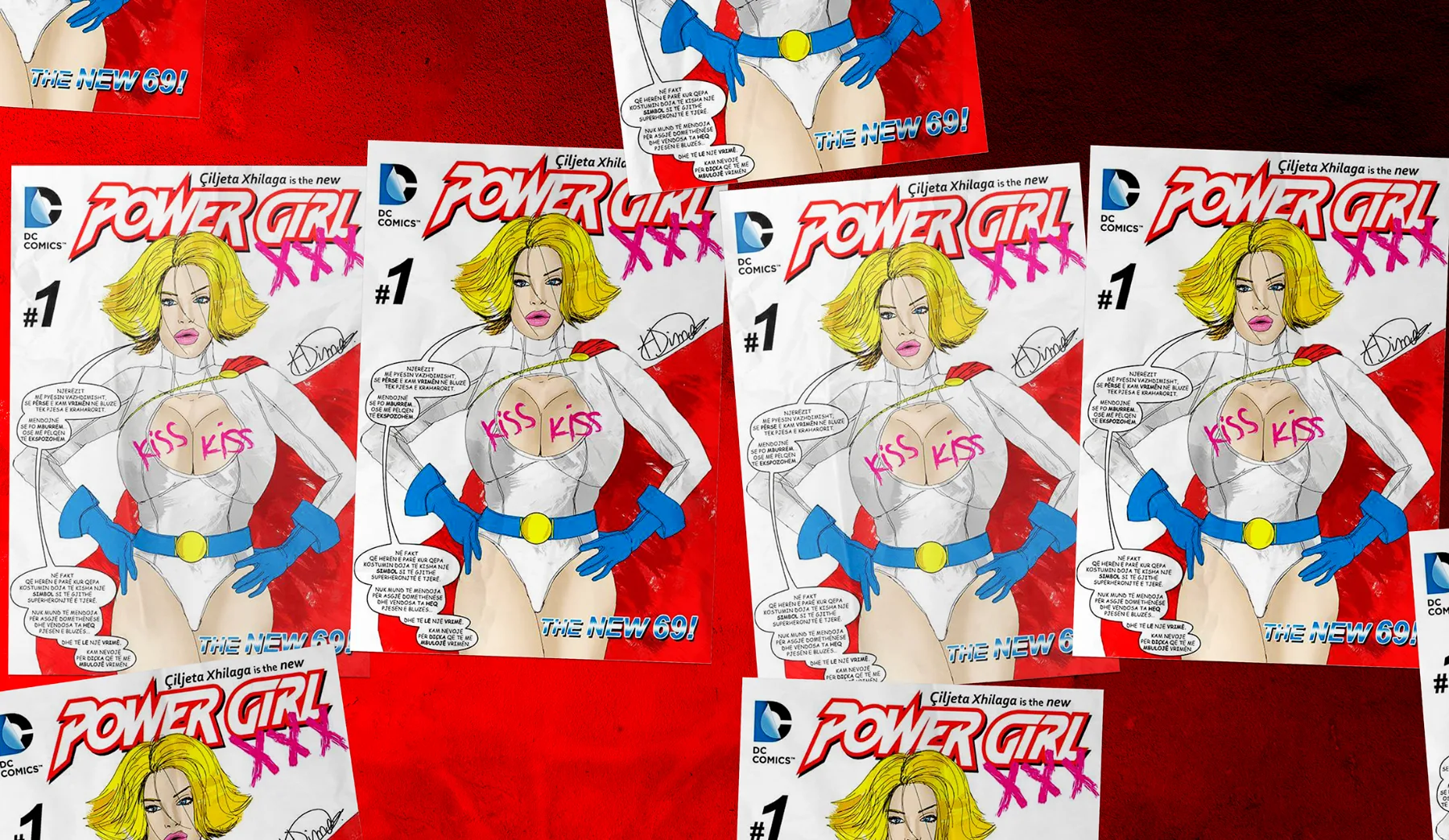
the celebrity as a collectable issue #1
mask and scalpel
The project therefore used satire as both a mask and a scalpel. The mask made the images approachable, allowing them to appear colourful, playful and even entertaining, while the scalpel cut beneath their surface, opening questions about how authority is packaged and consumed. Humour softened the first encounter, but it did not neutralise the message; instead, it carried it further, like sugar surrounding something bitter.
the internal archive
An archive that rearranges itself
Over time, I came to recognise that this method was connected not only to my education but also to the seemingly unrelated interests that had accompanied me throughout my life. Cinema, visual art, music, gaming, manga and comics have accumulated in my mind like an internal archive — a disorderly library of colours, characters, compositions, sounds, atmospheres and half-remembered scenes whose shelves are constantly rearranging themselves.
When I begin a new project, I rarely consult this archive consciously. The references often emerge by themselves, crossing the distance between different periods and media, connecting a frame from a film to a panel from a manga, a musical atmosphere to a political photograph, or the visual language of a video game to the identity of a contemporary brand. What initially appear to be isolated fragments begin to orbit one another until an unexpected context forms between them.
This is why, for me, a reference is never the final destination; it is raw material.
It must be questioned, broken apart and placed in a new relationship, where it can lose the certainty of its original function and begin producing another meaning. The creative act does not necessarily come from inventing everything out of nothing — as if imagination existed in a vacuum — but from recognising invisible connections between things that appear incompatible, then bringing them together with enough intention that their collision generates a new emotional and intellectual charge.
what stayed
Looking back, Enver Kissed Me was more than the project with which I completed my degree. It was the moment when I began to understand the kind of creative thinker I wanted to become: one who approaches visual culture with curiosity but also suspicion, who sees every image as a constructed object carrying traces of power, commerce, memory and desire, and who believes that even the most familiar symbol can reveal something new when removed from its pedestal and forced into conversation with its opposite.
That way of thinking has remained with me throughout my professional work, encouraging me to be critical without becoming cold, playful without becoming superficial and direct without surrendering complexity. It has taught me to search for combinations that should not work but somehow do, to connect the monumental with the commercial, the historical with the fictional and the serious with the absurd, until the distance between them produces enough tension to make the audience pause.
Because sometimes the strongest messages are not created by placing compatible things beside one another, but by bringing together elements that were never supposed to meet — and allowing the spark of that impossible encounter to illuminate both.
see the project